Does Airbnb translate messages? Yes, since 2022 — and the 4 things it doesn't translate
Updated 2026-08-26
Yes. Since summer 2022 Airbnb translates messages between hosts and guests automatically, into each reader's preferred language, in more than 60 languages; listing descriptions and reviews are translated the same way. It is on by default and each user can turn it off in their account settings. What it does not cover is everything outside the message thread: the sign on the door, the PDF you attach, the printed manual, the guest's partner who is not on the booking, and the guest whose phone has no signal at the door. Below: what the automatic translation covers, how to write so that it survives, and how to decide which languages to prepare in advance.
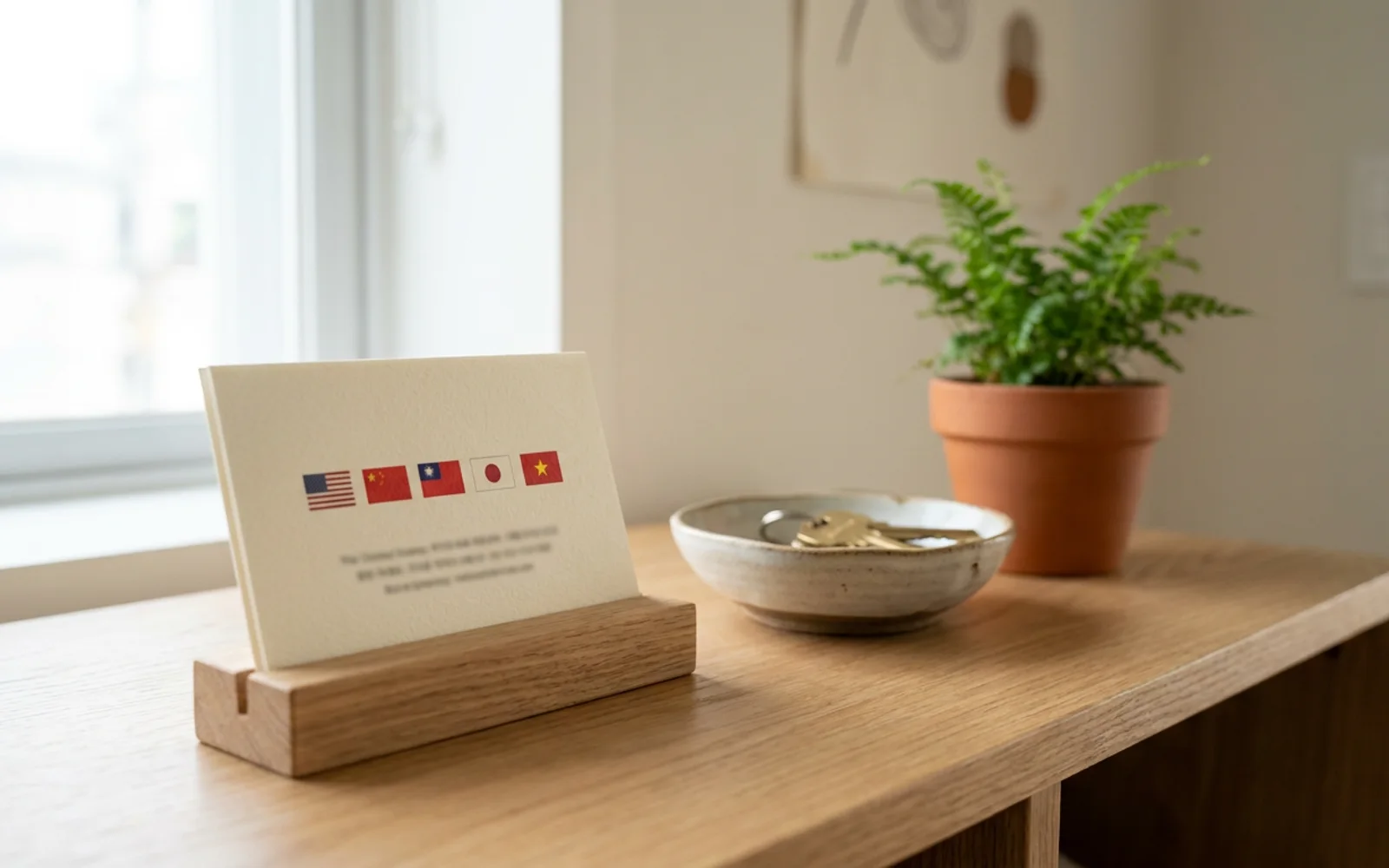
What does Airbnb translate, and what doesn't it?
Airbnb's announcement (September 2022) is specific: Translation Engine "removed the need for click-to-translate buttons" for listing descriptions in 2021, "was expanded this summer to include messaging," and from that date covers reviews as well. Messages "are automatically translated in the user's preferred language." Users choose in account settings whether reviews, descriptions and messages are translated into the language they view Airbnb in.
So a French guest messaging an English-speaking host sees the host's replies in French, and the host sees the guest's questions in English. For the conversation itself, the problem is solved.
| Where the words are | Translated by Airbnb? | Who reads it |
|---|---|---|
| Message thread | Yes, automatically | The person on the booking |
| Listing description, reviews | Yes | Anyone browsing |
| Check-in instructions inside the app | Written by you; shown as written | The person on the booking |
| PDF or image you attach | No | Whoever opens it |
| Printed sign, card, binder in the room | No | Everyone who walks in |
| Your own web page or link | Only if you made it so | Everyone with the link, including companions and off-platform guests |
The gap is the last four rows. A group of four books under one name; three of them never see the thread. A guest who booked through another channel has no thread. And the words that matter most at 11pm — the door code, "which button on the boiler" — are usually on paper or on a page, not in a message.
Writing so machine translation survives
Whether Airbnb translates your message or a tool translates your manual, the same things break. From our own work translating guest guides into five languages, the failures cluster in a short list:
- Values get "translated." A Wi-Fi password like
seaview2026can come back with a capital letter, a space, or a localised digit. Rule: network names, passwords, times and place names are not translated at all, and every number in the output must match the number in the source. We check digits mechanically after every translation. - Addresses become unusable for a taxi. A translated address is readable but a driver can't use it. Rule: address = translated line + original-language line, always both.
- Idioms and jokes. "Make yourself at home" is fine. "Don't let the bed bugs bite" comes back as an insect warning. Short declarative sentences translate; wordplay doesn't.
- Long paragraphs. Machine translation degrades with length; a numbered list of one-fact lines survives, a 120-word paragraph drifts. Write the manual the way you'd write it for the translation, and it will read better in English too.
- Register. Guests notice tone even through translation. Politeness that is normal in one language reads as cold or as gushing in another. Keep it neutral: "Please leave the key on the table" travels; "We'd be so grateful if you could kindly…" does not.
One more thing about doing it yourself: full translation of a guest guide takes time. In our tests, translating a complete guide (nine facts, all sections, notices) took 9–18 seconds per language, and one call in five hit a rate limit when we ran them back to back. That is fine once, in advance. It is not fine at the door. So translate once, store the result, and serve the stored copy — which is also how Airbnb does it for listing descriptions.
Which languages should you prepare?
Not all of them. Prepare the languages your guests actually arrive in, and let the rest fall back to English.
For a host in Korea, the arrivals data settles it. In April 2026 (Korea Tourism Organization monthly figures) the largest source countries were China (574,000), Japan (304,000), Taiwan (193,000), the United States (173,000), the Philippines (77,000), Hong Kong (71,000) and Vietnam (62,000). Two things follow that a host wouldn't guess from the raw list:
- Traditional Chinese is not optional. Taiwan and Hong Kong together (264,000) are more than the United States, and Taiwan was the fastest-growing of the top ten (+33.4%). Simplified Chinese shown to a Taiwanese guest is the wrong script — readable with effort, and noticed.
- The Philippines is served by English. Fifth by volume, but no separate language needed.
So the working set for Korea is English, Simplified Chinese, Traditional Chinese, Japanese and Vietnamese, with English as the fallback for everyone else — a Thai or German guest sees English, not Korean. That is the set Sonnim pre-generates for every guest page, and the fallback order is the same.
| Guest's language | Korea, 2026 | Prepared in advance? |
|---|---|---|
| Chinese (Simplified) | Largest source | Yes |
| Japanese | 2nd | Yes |
| Chinese (Traditional) | Taiwan 3rd + Hong Kong 6th | Yes — separate script |
| English | US 4th, Philippines 5th, and the fallback | Yes |
| Vietnamese | 7th | Yes |
| Thai, German, French, Russian… | Below the top seven | Fallback to English |
For a host elsewhere the list changes but the method doesn't: take your last year of bookings, count guest countries, prepare the top four or five, and make English the fallback. Prepare, don't translate on demand.
What hosts do, in practice
- Rely on Airbnb for the message thread. It works.
- Put the door code, Wi-Fi and times on the first screen of a page the whole party can open, in the guest's language, with the values untouched.
- Print the sign in the room in English plus the one or two languages you see most, or print a QR to the page and let the page switch.
- Write short. One fact per line. No idioms. Numbers checked after translation.
One line at the end
Sonnim does steps 2 and 4 for you: paste your guide once, and the guest page comes out in the five languages above, with passwords, times and addresses checked so they survive the translation.
For the messages themselves, the free host message templates give you booking confirmation, check-in and check-out messages already written in five guest languages — enter your property name and times, copy, paste into Airbnb's scheduled messages.
Sources
- Airbnb Newsroom, "Translation Engine launches Reviews after expanding to Messages this summer" (8 Sept 2022) — https://news.airbnb.com/translation-engine-launches-reviews-after-expanding-to-messages-this-summer/
- Airbnb Help Center, account settings (translation toggle) — https://www.airbnb.com/help/article/280
- Korea Tourism Organization, monthly inbound arrivals by country, April 2026 (as recorded in Sonnim's language-selection notes)
- Sonnim translation checks (digits kept, Wi-Fi/password/time untranslated, address in two lines) and timing measurements (9–18 s per full guide)